Executive Consultant · ACE Integrated Innovations
Seeing the Whole System.
Independent operational judgment for complex organizations with extensive physical assets. I help leadership see where individually reasonable decisions stop working together, before those decisions become expensive dependencies.
The problem
Most serious operational failures begin in the space between responsibilities.
When every department is right, the organization can still be wrong.
Mapping the way
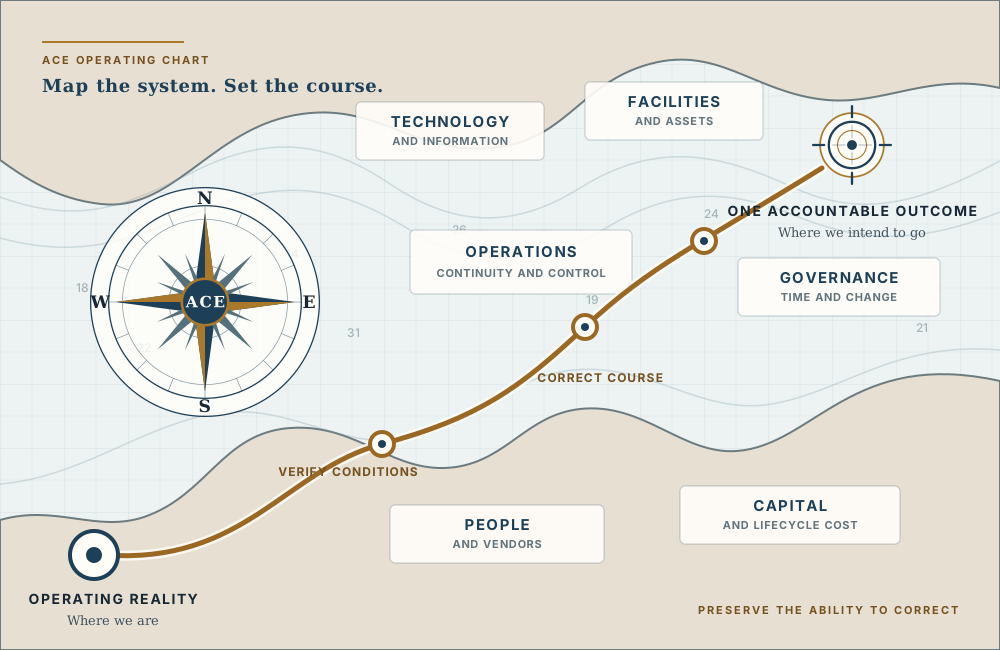
Direction is not enough. The route must reflect reality.
A compass establishes direction. A chart reveals the conditions between where the organization is and where leadership intends to go. ACE maps the assets, people, technology, capital, dependencies and constraints, then helps leadership set a workable course and continually verify it.
Facilities makes one decision. Finance makes another. Technology changes direction. Construction moves forward. Vendors respond to their individual scopes. Operations inherits the result.
Every decision may make sense on its own while the system as a whole becomes harder to operate, more expensive to maintain, or increasingly dependent on assumptions nobody has challenged.
That is where I work.
I help owners, executives, boards, investors, and operating teams look across the entire system before individual decisions become difficult or expensive to reverse.
The objective is not to replace the people responsible for those functions. It is to make sure their decisions ultimately support the same outcome.
The missing responsibility
Someone has to own the whole outcome.
- Does the design support the way the facility will actually operate?
- Has construction considered what happens after turnover?
- Are technology assumptions moving faster than the assets being built around them?
- Does the capital plan reflect operational reality?
- Do vendor contracts protect the organization when conditions change?
- Are we preserving alternatives, or quietly designing ourselves into a corner?
- Which assumptions in our plans still need to be tested under actual operating conditions?
Where I add value
From readiness to resilience.
Operational readiness
Test whether the people, processes, vendors, maintenance, documentation, infrastructure, reporting and accountability surrounding an asset are ready to operate.
Construction to operations
Examine the handoff from design and construction into actual operation, where decisions made years earlier finally meet the people expected to live with them.
Dependency risk
Identify where power, water, technology, supply chains, vendors, transportation and people create exposure and where options should be preserved.
Owner representation
Translate across engineering, construction, finance, technology and operations so leadership understands the combined consequence of individual recommendations.
Lifecycle judgment
Evaluate maintainability, operating cost, resilience, technology refresh, vendor dependency and future flexibility before choices made for the short term become commitments for the long term.
Interim leadership
Provide experienced operational leadership through transitions, expansion, restructuring, acquisitions, performance recovery or leadership gaps.
- Large communities and environments with mixed uses
- Resort, marina and coastal assets
- Property and service organizations spanning multiple sites
- Hospitals and healthcare facilities
- Hotels and high rise portfolios
- Infrastructure investors and ownership groups
- Engineering, construction, EPC and O&M
- Utilities, water and energy systems
- Data centers and facilities essential to operations
- Airports and transportation assets
I am not geographically limited. The common denominator is complexity, dependency, significant capital, and an operation where getting the interfaces wrong can become very expensive.
I have led large operating organizations, managed substantial budgets and workforces, worked across technology and physical infrastructure, and spent decades making decisions where the answer rarely belonged to one department.
What I bring is the ability to enter a complicated situation, understand how the pieces depend on one another, identify what may have been missed, and help leadership make a better decision that accounts for the whole system.
Technology changes. Assets change. Organizations change. The need to understand how they work together does not.
Integration does not eliminate error. It creates a process capable of discovering and correcting error before dependency makes correction impossible.
ACE Integrated Innovations
Bring me the consequential question.
If your organization is facing a complex operational decision, transition, investment, handoff or infrastructure challenge, I would welcome the conversation.